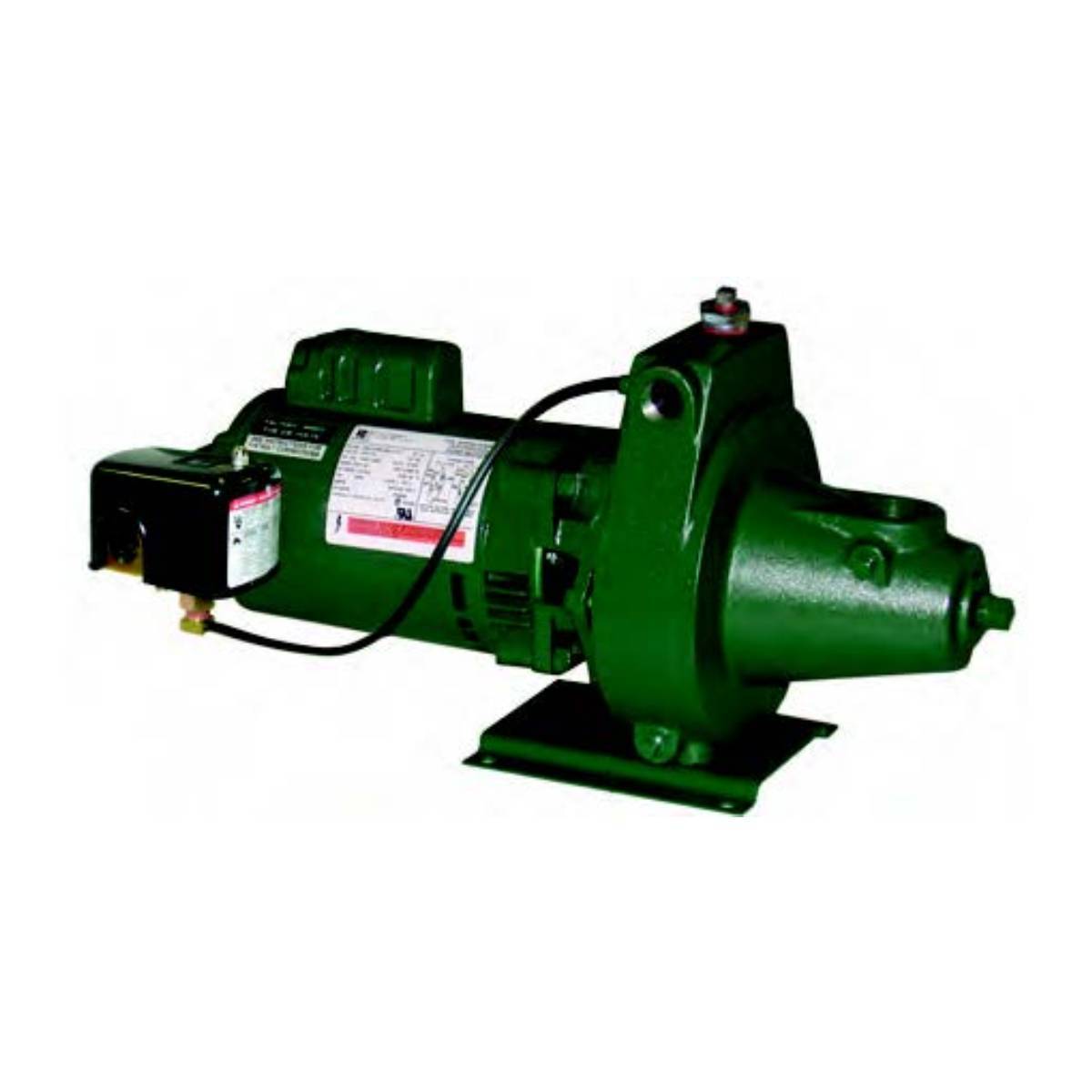
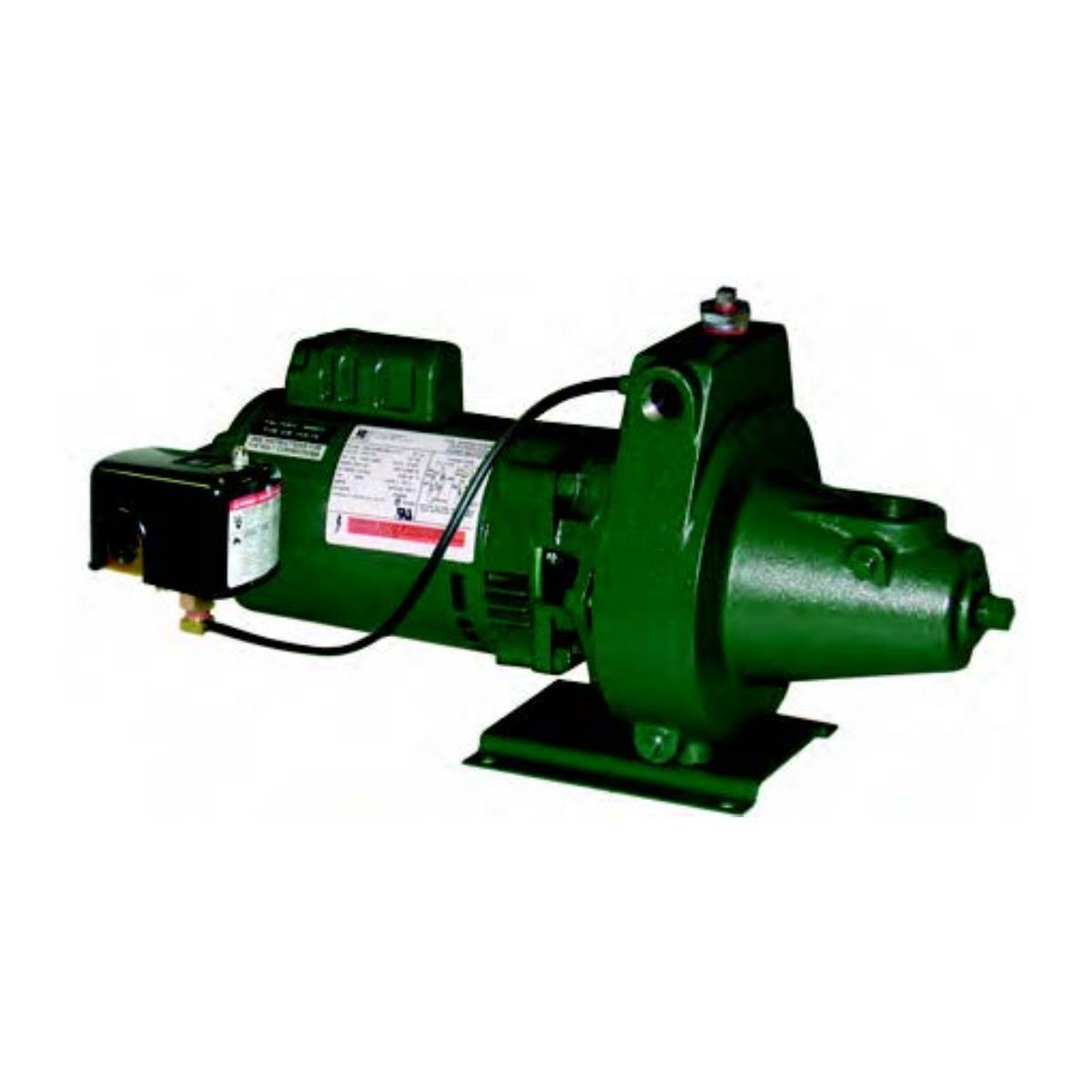
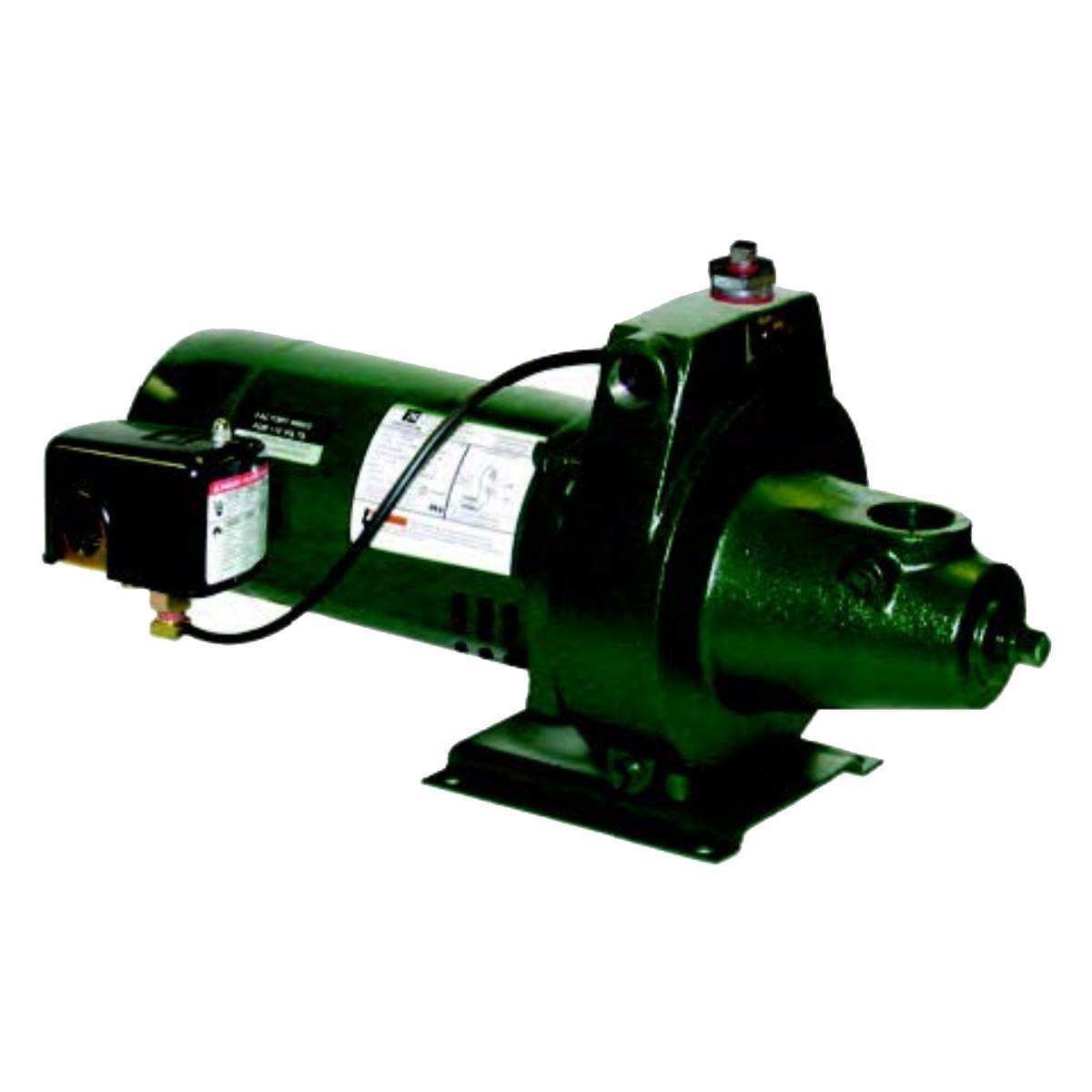
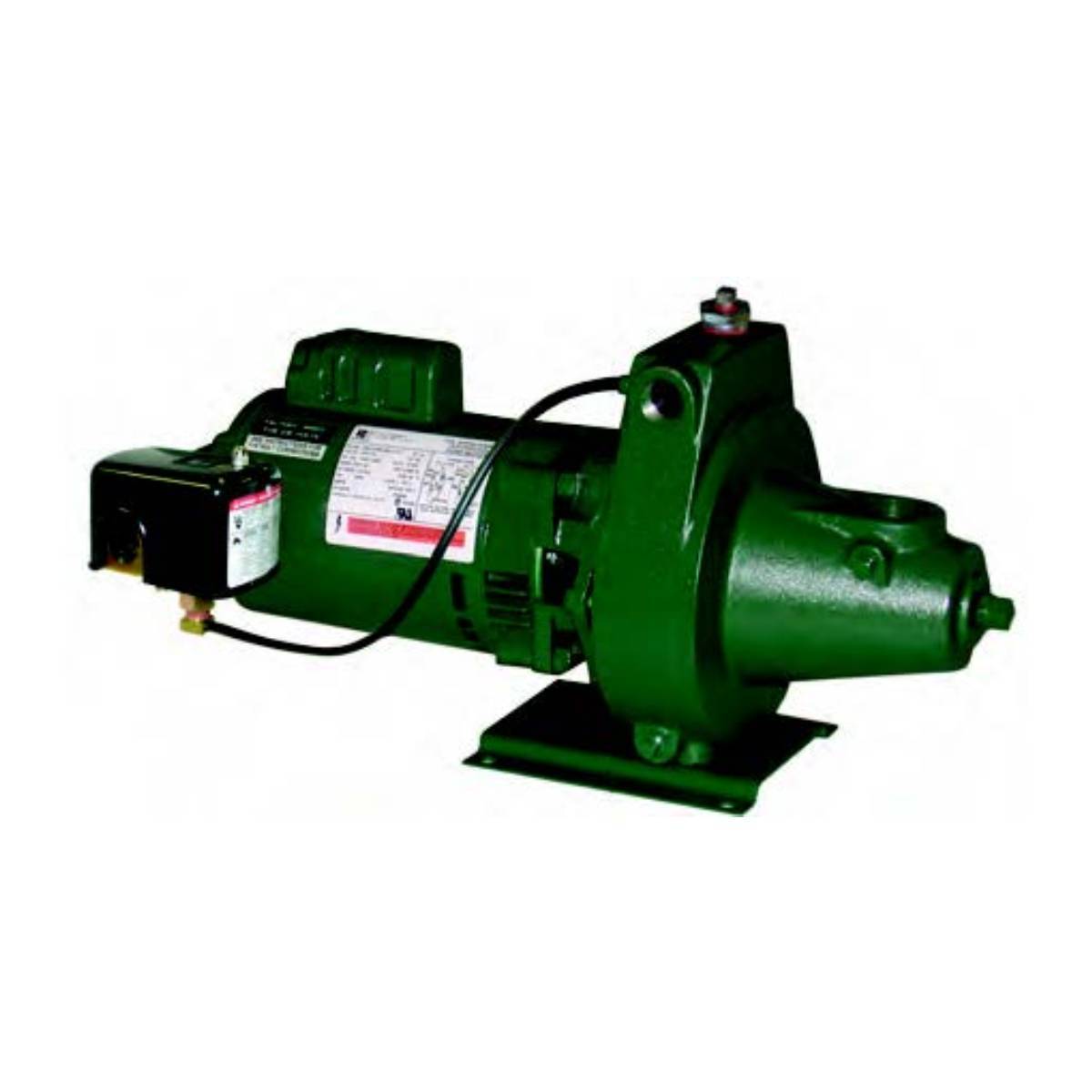
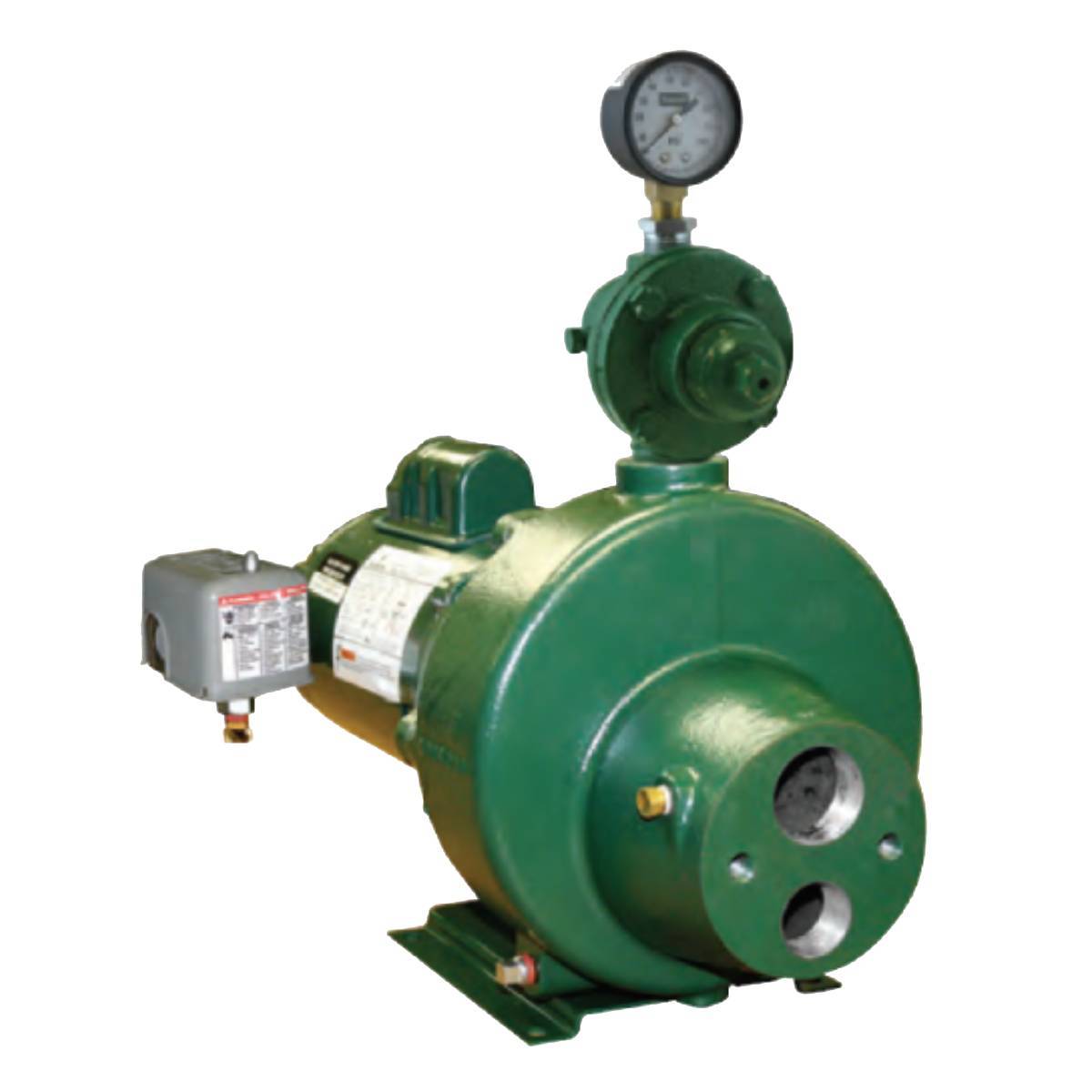
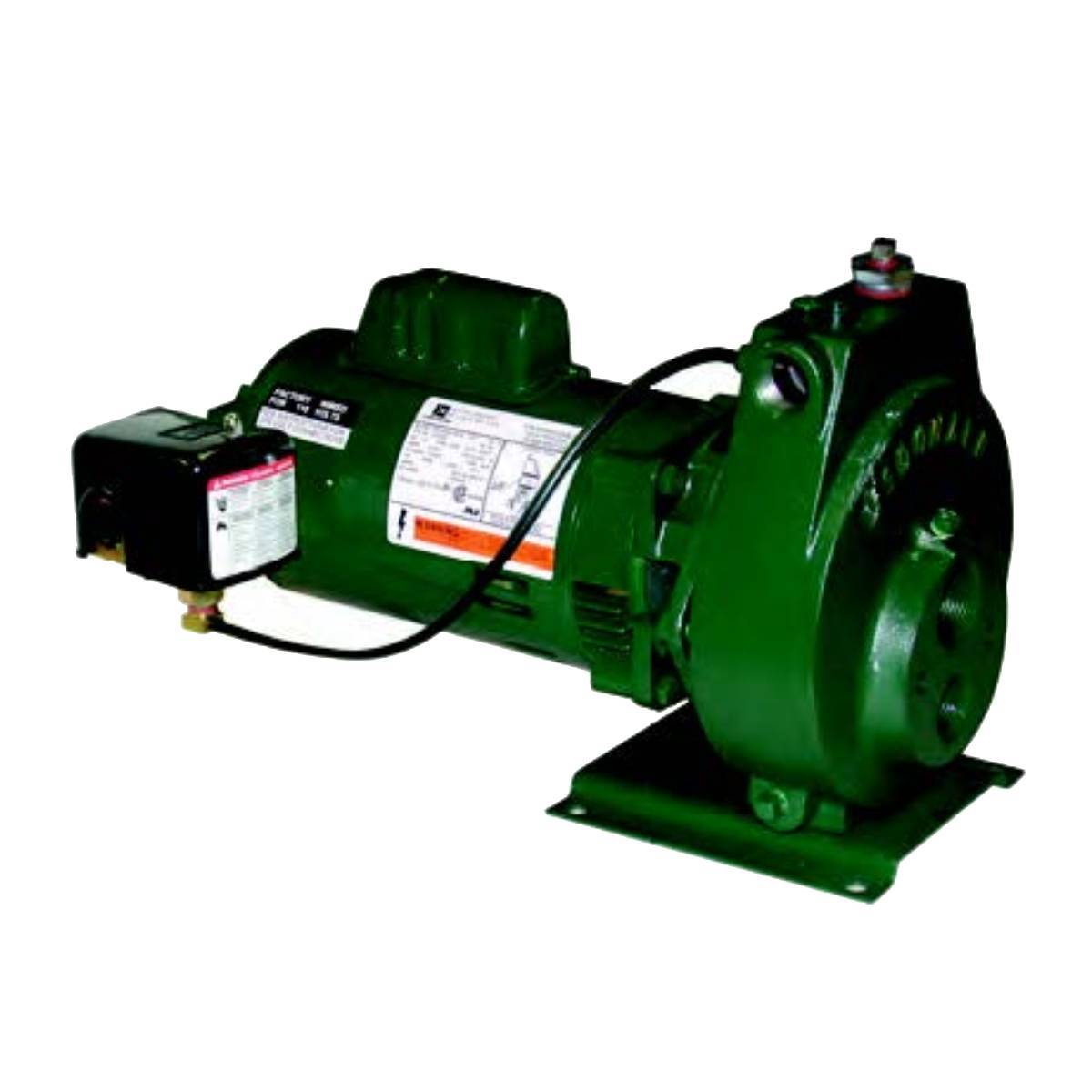
Jet pumps sit above ground and pull water up from a well, driven point, cistern, storage tank, lake or creek — the standard answer for a property that is not on a city main.
Shallow well pumps handle water within about 25 ft of the pump with the ejector built in. Convertible pumps run either way: shallow with a bolt-on ejector, or past 25 ft with an ejector down the well. Multi-stage pumps stack impellers to reach high pressure on less horsepower, and dedicated deep well pumps take over where suction runs out.
We sell four lines — A.Y. McDonald (Baker Water Systems), Franklin Electric, Goulds Water Technology and Grundfos — from 1/3 through 2 HP, along with the ejectors, pressure tanks, foot valves and repair parts that complete a system.
Not sure which you need? Send us the depth to water while pumping, your well yield, the flow and pressure you need, and your supply voltage. We size the pump, ejector, tank and piping as one system, free with every quote.
Shallow Well · Convertible · Deep Well · Multi-Stage
Jet Pumps For Wells, Cisterns & Surface Water
Water pressure for properties that are not on a city main. Four manufacturers, every configuration from a 25 ft shallow well to a 150 ft deep well, 1/3 through 2 HP. Written so that you do not need to know anything about pumps to end up with the right one.
4 BrandsA.Y. McDonald · Franklin · Goulds · Grundfos
18 SeriesShallow, convertible, deep, multi-stage
1/3 - 2 HPRated motor output
25 - 150 ftDepth to water covered
NSF 61 / 372Potable water certification
Jet pumps sit above ground and pull water up from a source below them — a shallow well, a driven point, a cistern, a storage tank, a lake or a creek. They are the standard answer for a house on a private water source where the water is within reach of suction, and with a down-hole ejector they reach well past it. The first half of this page explains how they work in plain English; the second half covers what we supply and how the brands differ.
We supply jet pumps from A.Y. McDonald (Baker Water Systems), Franklin Electric, Goulds Water Technology and Grundfos in shallow well, convertible, deep well and multi-stage configurations, with the ejectors, tanks, foot valves and repair parts that complete a system. Tell us your depth to water, well yield, required flow and voltage and we will size the whole thing — call 1-888.510.4036 or email sales@watermainsupply.com. All products on this page are genuine, factory-new equipment in original manufacturer packaging, sold and supported by Watermain Supply, an independent industrial supplier.
What Is a Jet Pump?
A pump that sits above the water and pulls it up, using a clever trick to beat the limits of ordinary suction.
It is a centrifugal pump underneath
Every jet pump starts as an ordinary centrifugal pump. Inside is a spinning vaned disc called an impeller, driven by the motor at around 3,450 revolutions per minute. Water at the centre of the impeller is flung outward by that spin, like water flying off a spinning umbrella. That does two jobs at once: it throws water out of the pump at pressure, and it leaves a low-pressure hole at the centre that more water rushes in to fill. That is the whole principle, and it is why a jet pump is correctly called a centrifugal pump.
The “jet” part is the clever bit
A plain centrifugal pump is poor at pulling water up a long pipe. So instead of sending all its pressurised water to the house, a jet pump sends a portion backwards into a small assembly called the ejector, or jet. There the water is forced through a narrow nozzle, converting slow high-pressure water into a fast squirt, which fires through a slightly wider cone called the venturi. Fast-moving water has low pressure — physics, not a trick — so suction is created at that point, and that suction drags well water up into the pump. In one sentence: a jet pump is a centrifugal pump that borrows a little of its own output to help itself suck.
What happens when you open a faucet
Inside the pump
1. Pressure drops in the house
Water leaves the pressure tank, tank pressure falls, and at the cut-in setting the pressure switch closes the motor circuit.
2. The impeller spins
Water already in the casing is flung outward, producing discharge pressure and a low-pressure zone at the impeller eye.
3. Part of the flow is recycled
Pressurised water is diverted back through the nozzle and venturi. The high-speed jet creates suction on the well side.
4. Well water is drawn up
It joins the recycled water, passes through the impeller, and the surplus goes to the house while the rest keeps the jet running.
5. The tank refills, pump stops
At cut-out the switch opens, and the tank supplies the house until pressure drops again.
What “self-priming” actually means. Priming means filling the pump body and suction pipe with water. A pump cannot pull water while full of air, because an impeller spinning in air just makes warm air — air is far too light to be flung outward with any force. Self-priming means the pump can clear remaining air out of the suction pipe by itself once its casing has been filled by hand; it does not mean the pump primes from dry. Every jet pump here must be filled through its priming plug before the first start, and running one dry, even for seconds, destroys the mechanical seal — the mistake that causes more failures than everything else combined.
What Is Inside a Jet Pump
Ten parts. Once you can name them, every spec sheet and troubleshooting article becomes readable.
Motor
Single-phase, almost always 3,450 rpm, wired for 115 V or 230 V. A built-in thermal overload shuts it down if it overheats and restarts it once cool. The part that dies from short-cycling.
Impeller
The spinning vaned disc that does the pumping. Brass, thermoplastic or stainless steel. Larger diameter and higher speed mean more pressure.
Diffuser
A stationary shroud with widening passages around the impeller. It slows the fast water leaving the impeller and converts that speed into pressure. Cheap pumps skimp here.
Nozzle and venturi
The two-piece heart of the jet: the nozzle makes the squirt, the venturi captures it and recovers pressure. Sized to horsepower and depth — built into shallow well pumps, hung down the well on deep systems.
Casing or volute
The pump body that contains pressure and routes water. Cast iron on most models, thermoplastic on non-corrosive models, 304 stainless on the Grundfos JP PS.
Mechanical seal
Two polished faces, usually carbon against ceramic, keeping water in the pump and out of the motor. Cooled and lubricated by the water passing it — which is why dry running ruins it in seconds.
Pressure switch
The electrical brain. A spring-loaded diaphragm senses pressure, closing the motor contacts at cut-in and opening them at cut-out. Usually factory set at 30-50 psi.
Priming and drain plugs
The port on top you pour water into before the first start, and the one at the bottom you open to drain the pump before a freeze.
Pressure tank (bought separately)
A steel tank with a rubber diaphragm and compressed air behind it, storing water under pressure so the pump does not start every time somebody washes their hands. Not optional.
Foot valve or check valve (bought separately)
A one-way valve with a strainer at the bottom of the suction pipe. It holds water in the pipe when the pump stops so prime is not lost, and keeps debris out of the pump.
A jet pump is never a standalone purchase. Every install needs the pump, a pressure switch (fitted at the factory on every model here), a pressure tank, and a foot or check valve at the source. Deep well systems add an ejector, a pressure control valve, and on 2 in casings a packer adapter. Browse pressure tanks, check and foot valves and jet pump accessories, or let us build the list.
Shallow Well, Convertible or Deep Well?
Everything hinges on one measurement: how far it is straight down from the pump to the surface of the water while the pump is running. Not the depth of the well — the depth to the water.
Shallow well
Convertible
Deep well
Water depth it suits
Up to about 25 ft
Either, depending on setup
Past 25 ft, to 150 ft
Where the ejector sits
Inside the pump, from the factory
Bolt-on at the pump face, or down the well
Down the well, below the water
Piping
One suction pipe
One pipe shallow, two paths deep
Twin-pipe (4 in casing) or packer (2 in casing)
Extra parts required
Foot valve
Shallow ejector, or deep ejector plus control valve
Ejector, pressure control valve, packer adapter on 2 in
Unknown or falling water level, more than one source
Drilled wells past the suction limit
Installation complexity
Simplest
Moderate
Highest
Relative cost
Lowest
Pump costs a little more, ejector extra
Highest
The three configurations. Shallow well needs only a pump, a tank and a single pipe. Twin-pipe deep well drops two pipes and a jet assembly into the well and adds a pressure control valve. Packer deep well uses one pipe plus the casing itself as the drive path.
Why 25 ft is the wall nobody gets past. A pump does not really suck. It removes pressure from the top of the pipe and lets the weight of the atmosphere — 14.7 psi at sea level — push water up from below. Atmospheric pressure supports a water column about 33.9 ft tall, and no pump of any brand or price beats that, because there is nothing beyond a perfect vacuum. In practice you never get one: pipe friction, fittings, temperature and pump efficiency eat into it, and altitude costs roughly 1 ft per 1,000 ft above sea level. What remains is about 25 ft of usable suction lift, which is why every shallow well pump ever built stops near the same number. Past that, extra horsepower will not help — you need the ejector down the well, or a submersible.
Measure the pumping level, not the static level. The static water level is where water sits when nothing runs. The pumping water level is where it settles while the pump works, and it is always lower — the difference is drawdown, which on a weak well can be 10 or 20 ft. A pump sized against the static level works beautifully for ten minutes, then loses prime every time someone showers. Ask your driller for the pumping level, or measure it with a water-level tape while the pump runs.
What “Multi-Stage” Means
A stage is one impeller and one diffuser working together. Single-stage pumps have one. Multi-stage pumps have two or three, stacked in line inside the same casing.
In a multi-stage pump, water leaving the first impeller does not go to the house. It feeds straight into the eye of the second, which adds its own pressure on top, and a third stage adds more again. Think of three people passing a bucket up a ladder rather than one person throwing it all the way: each stage does an easy amount of work and the total is far higher than any one could manage alone.
The consequence that matters: stages add pressure, not flow. Three stages give roughly three times the head at about the same gallons per minute. That is exactly what a deep well, a two-storey house, a long uphill run, or a system that must hold 60 to 70 psi at the tap needs. The alternative route to high pressure is a much larger single-stage motor, which works but wastes electricity, runs hotter and shortens motor life. A multi-stage pump gets there on less horsepower.
The multi-stage jet pumps we supply are the A.Y. McDonald 1500 (3/4 - 1-1/2 HP, to 40 gpm and 100 psi) and the 1500SW, which ships without the regulating valve for simpler shallow and potable installs; and from Goulds the HSJ convertible multi-stage (0.75 - 2 HP, two or three stages) and the SJ vertical deep well pump. Full specifications are in the brand tables below.
Choose multi-stage when working pressure needs to exceed roughly 60 to 80 psi, the well is deep, or long uphill runs and a second storey push your required head up. Stay single-stage when it is a normal single-storey house on a shallow source — you would be paying for pressure you never use.
The Pressure Switch and the Pressure Tank
These two decide whether your pump lasts twenty years or two. Worth understanding properly.
Why a pressure switch is needed
A jet pump has no idea whether anyone wants water — it runs when it has power and stops when it does not. The pressure switch supplies that awareness: a spring-loaded diaphragm reads system pressure and closes the motor contacts at the cut-in point, then opens them at cut-out. Without one you would have a pump running continuously against a closed system, building pressure until something burst. The switch is also the pump’s power connection point — supply lands on the switch terminals, not directly on the motor. Standard settings are 20-40, 30-50 and 40-60 psi; most pumps here ship at 30-50.
Why a pressure tank is needed
A pressure tank is a steel vessel divided by a rubber diaphragm, with compressed air on one side and water on the other. When the pump runs, water is forced in and the air is squeezed; when you open a tap, that air pushes water back out. It is a battery for water pressure, and its real job is to stop the motor starting. Without one, every hand wash and toilet fill starts the pump for a couple of seconds — and motors are damaged by starting, not running, because each start draws several times the running current. A correctly sized tank turns fifty short starts into three long ones.
Switch setting
Tank pre-charge, tank empty
What you feel at the tap
20 - 40 psi
18 psi
Gentle. Fine for a single-storey cabin with few fixtures.
30 - 50 psi
28 psi
The normal household setting, and what most pumps ship with.
40 - 60 psi
38 psi
Strong. Suits two-storey homes and long runs — confirm the pump reaches 60 psi at your flow first.
Set the pre-charge with the tank empty of water, always 2 psi below cut-in, and check it once a year with a tyre gauge. Never set cut-out above the pump’s maximum working pressure or the tank rating; if the pump cannot reach cut-out at your duty point it will simply run and never shut off.
Short-cycling is the silent pump killer. Short-cycling means the pump starts and stops rapidly — on for two seconds, off for five — and it destroys a motor and switch in months. Three real causes. One: the tank has lost its air charge, so there is almost no storage left; check the pre-charge with the tank drained. Two: a failed check or foot valve is letting pressurised water leak backwards. Three: a restriction between pump and tank — a partly closed valve, a filter, or a standard rather than full-port ball valve — so the switch sees pressure the tank never receives. If your pump is clicking on and off, fix the cause; it is not a habit it grows out of.
What “Total Head” Means
Every pump specification in the world is written in head. Understand this one idea and you can read any pump catalogue.
Head is pressure measured in feet. Rather than saying a pump produces 43 psi, engineers say it produces 100 ft of head — meaning it could push a column of water 100 ft straight up before running out of push. The two units convert directly: 1 psi = 2.31 ft of head, and going the other way, 1 ft of height = 0.433 psi. So a pump rated at 187 ft of head produces about 81 psi at zero flow.
Total head (engineers say total dynamic head) is everything the pump must overcome: suction lift from the pumping water level up to the pump, plus discharge elevation from the pump to the highest fixture, plus the pressure you want at the tap converted to feet, plus friction loss in the pipe. Add the four and that is the head your pump must produce at the flow you need. Those last five words are where most people go wrong.
Worked example: two-storey house on a shallow well
Value
Where it comes from
Suction lift
18 ft
Pumping water level 18 ft below the pump — under 25 ft, so a shallow well pump is viable.
Discharge elevation
22 ft
Pump in the pump house, highest fixture is an upstairs shower head.
Pressure wanted at the tap
115 ft
50 psi × 2.31. Usually the biggest number in the sum, and the one people forget entirely.
Friction loss
12 ft
120 ft of 1-1/4 in pipe at 10 gpm plus elbows and a foot valve.
Total head required
about 167 ft at 10 gpm
Find a pump whose curve passes through 167 ft at 10 gpm, not one whose maximum head is 167 ft.
Maximum head is not a duty point. When a catalogue says a pump makes 187 ft of head, that is measured at zero flow — discharge shut tight, no water moving. It is the theoretical ceiling: useful for comparing pumps, useless for sizing one, and the same pump may make only 90 ft at 15 gpm. Equally, a quoted 25 gpm is usually at almost zero pressure. Flow and pressure trade against each other continuously, and the only honest way to size a pump is to find the point on its curve where the flow you need meets the head you need.
How to Read a Pump Performance Curve
The curve is the pump’s honest resume. Six steps to read one.
1. Identify the axes
Flow in gallons per minute runs along the bottom. Head in feet runs up the side. Every point on the curve is a pair: this much water, at this much pressure.
2. Note where the curve starts and ends
The far left is shut-off head: maximum pressure at zero flow. The far right is maximum flow at almost zero pressure. Real operation lives between them.
3. Find your flow on the bottom axis
If you need 10 gpm, put a finger on 10 along the bottom axis and go straight up until you meet the curve.
4. Read across to the head
From that point go straight left to the vertical axis. That is the head the pump actually produces at 10 gpm. Above your required total head, the pump works. Below it, it does not.
5. Check which curve you are on
Jet pump charts often show several curves at once — one per suction lift, or one per model. Make sure you are reading the line that matches your lift and model.
6. Stay in the middle third
Pumps are most efficient and last longest in the middle of the curve. Running hard against either end wastes energy and wears the pump. Aim for a duty point in the central third.
Want the longer version? See Pump Curve 101 for efficiency islands, system curves and where the operating point actually lands. For step-by-step A.Y. McDonald installation, ejector selection by depth, priming, wiring and repair parts with part numbers, see the A.Y. McDonald Jet Pump Guide.
How to Choose Horsepower
Horsepower is an output of the sizing process, not an input. Work out flow and head first and the horsepower falls out at the end.
1. Work out the flow you actually need
Not every fixture added together — nobody runs every tap at once. Count fixtures and use a realistic simultaneous demand. For a house the table below starts the conversation; for commercial work we run the proper fixture-unit calculation.
Property
Realistic peak demand
Usual starting point
Cabin, one bathroom
4 - 6 gpm
1/2 HP shallow well
House, two bathrooms
8 - 12 gpm
1/2 to 3/4 HP
House, three bathrooms plus appliances
12 - 18 gpm
3/4 to 1 HP, high-capacity configuration
House, four bathrooms plus irrigation
18 - 25 gpm
1 HP and up, or reconsider the pump type
Irrigation, per zone
10 - 20 gpm per zone
Multi-stage if working pressure exceeds 60 psi
Livestock, 50 head
5 - 8 gpm continuous
Continuous duty rating matters more than peak flow
Starting points only. Fixture count, pipe size, elevation and well yield all move these numbers. Send us the details and we will run it properly.
2. Add up your total head
Suction lift, plus discharge elevation, plus desired pressure in feet, plus friction — the worked example above shows how. If the answer exceeds roughly 150 ft, look at multi-stage before you look at a bigger single-stage motor.
3. Find the pump that meets both at once
Pick the smallest pump whose curve passes above your flow-and-head point with a little margin. That is your horsepower, and it is normal for the answer to be smaller than you expected.
4. Check the limits that have nothing to do with head
Is the water within 25 ft? Does the well yield what the pump moves? Is the supply 115 V or 230 V, and the circuit rated for starting current? Is the water potable, so NSF 61 matters? Is there iron, sand or hardness that should drive the impeller choice? Any one of these can rule out an otherwise perfect hydraulic selection.
Is it okay to oversize a jet pump? No. Buying bigger than you need feels like cheap insurance and is the opposite, because a pump does not decide how much water to move — the system does. Put an oversized pump on a small system and it races out to the far right of its curve, moving more water than the piping or the well can supply. Four things go wrong. The well gets out-pumped: you draw the level down faster than the aquifer refills, so the pump breaks suction and runs dry. You cavitate: excess suction vaporises water at the impeller eye and the collapsing bubbles pit the impeller like sandblasting. It short-cycles: the tank fills so fast the pump runs four seconds and rests thirty, and the motor dies of starting current. You pay twice: higher price and a higher power bill for water you never use. The one legitimate reason to go up a size is a documented plan to add load within a couple of years — and even then go up one step, never two.
Undersizing is not the safe alternative either. An undersized pump runs continuously trying to reach a cut-out pressure it can never make, cooking the motor and giving weak showers the whole time. The goal is not small or large, it is correct. If you are genuinely between two sizes, that is the moment to call rather than guess.
What to Consider When Buying a Jet Pump
Eight things that decide whether the pump you receive is the right one. Have answers to these and any supplier can help you properly.
Consideration
Why it matters
What to find out
Depth to water
Decides shallow versus convertible versus deep. Nothing else matters until this is settled.
Pumping level, not static level. Ask the driller or measure it.
Well yield
A pump that moves more than the well produces will run dry no matter how good it is.
Recovery rate in gpm from the well log or a drawdown test.
Casing size
Deep well ejectors are built for either 2 in or 4 in casing and are not interchangeable.
Actual inside diameter, measured, not nominal.
Flow and pressure needed
Together they set the duty point. Over-estimating flow leads straight to an oversized pump.
Fixture count, realistic simultaneous use, and target psi at the highest fixture.
Voltage available
Nearly all these pumps are dual voltage, but the motor must be set to match before power is applied.
115 V or 230 V, and the breaker size.
Water chemistry
Iron, sand, sulphur and hardness attack impellers and seals at very different rates.
A water test, or at least a look at existing fixture staining.
Potable or not
Drinking water systems should use NSF 61 and NSF 372 certified equipment.
Whether anyone will drink, cook or bathe in this water.
Freeze exposure and parts
An unheated pump house in a cold snap cracks a cast iron casing, and every pump eventually needs a seal or impeller.
Whether the pump can be drained, and whether repair kits, motors and ejectors are available for the line.
Send us five numbers and we will do the rest. Depth to water while pumping, well yield in gpm, casing inside diameter, flow and pressure needed, and supply voltage. Call 1-888.510.4036 or email sales@watermainsupply.com and we will come back with the pump, ejector, tank size and pipe size as one package. Engineering-led selection on every quote, at no charge.
How to Make a Jet Pump Last Twenty Years
Jet pumps are simple machines. Almost every early failure traces back to one of these eight things.
Never let it run dry
Seconds of dry running scores the seal faces and starts a slow leak into the motor. Prime completely before the first start, and fix loss-of-prime problems rather than restarting repeatedly. The single biggest killer.
Check the tank pre-charge yearly
Drain the system, put a tyre gauge on the tank valve and confirm 2 psi below cut-in. A tank that has lost its charge is the most common cause of short-cycling, and short-cycling kills motors.
Size it correctly in the first place
An oversized pump cavitates and short-cycles; an undersized one never shuts off. Neither reaches its design life, and correct sizing costs nothing.
Keep the suction side airtight
Air leaks make the pump lose prime, run partly dry and cavitate. Double-clamp poly connections and check unions first whenever performance drops.
Do not restrict flow between pump and tank
A partly closed valve, a filter, or a standard rather than full-port ball valve makes the switch see pressure the tank never receives. Use full-port valves only and put filters downstream of the tank.
Match the impeller to the water
Brass for clean, soft water. Thermoplastic for hard water, mild iron and sandy aquifers, where it will not corrode or pit. Plastic with a stainless insert when the chemistry is unknown.
Protect it from freezing
Drain the casing through the bottom plug before a hard freeze, or keep the pump house above freezing. A cracked cast iron casing is not repairable; multi-stage pumps may need tipping or blowing out to clear every stage.
Keep spare wear parts on hand
A mechanical seal, a body gasket and an impeller and diffuser kit are inexpensive and turn a week without water into an afternoon. On deep well systems a spare nozzle and venturi is worth having.
The Four Lines We Supply
Every brand here builds a good pump. They are not the same pump, and the differences below are the ones that change a purchase decision.
A.Y. McDonald — Baker Water Systems
The deepest line we stock and the one we support end to end: pumps, matched ejector packages by horsepower and depth, motors, impeller and diffuser kits, seals, foot valves and switches. Cast iron throughout, NSF/ANSI 61 and 372 certified, brass or thermoplastic impeller on most series. If the system may need service in ten years, this is the safest line to own. Watermain Supply is an Authorized Stocking A.Y. McDonald and Baker Water Systems Distributor.
3/4 - 1-1/2 HP, to 40 gpm and 100 psi. NEMA C keyed shaft. SW models omit the regulating valve for simpler potable installs.
Deep well ejector selection by horsepower and depth, pressure control valves, packer adapters, replacement motors, impeller kits, installation and priming step by step — all with part numbers — are in the A.Y. McDonald Jet Pump Guide. Shop jet pump accessories and pump repair parts.
Franklin Electric
Built around serviceability. The VersaJet Quick-Change nozzle system converts the same pump between a high-pressure and a high-flow setup without opening the casing — useful when the well turns out different from what the driller described. The SWJ Cyclone is fully thermoplastic for corrosive water, and the Convertible Pro is the only three-phase option here. Franklin certifies these models to NSF/ANSI/CAN 372 for lead-free construction; unlike the other three brands they do not publish an NSF/ANSI 61 listing on these pumps, which matters if your specification calls for 61.
1/2 - 1 HP, to 23 gpm, lifts from 100 ft. Stainless impeller; internal injector swaps for a bypass plug to go deep. 150 psi working. Three-phase 230/460 V available.
1/2 - 3/4 HP, to 16 gpm. Cast iron volute, stainless impeller, screw-in injector with bypass plug. Deep well injector kits ordered separately.
Goulds Water Technology
Xylem’s Goulds line sits at the premium end. Cast iron casings with electrocoat finish baked on inside and out, glass-filled composite impellers, back pull-out servicing, and a diaphragm design that keeps water in the casing so the seal cannot run dry — useful given how most jet pumps die. Goulds is also the only brand here with a purpose-built vertical multi-stage deep well pump rather than a convertible plus an ejector.
JS+ is built in the USA with the jet integral to the casing, 0.5 - 1.5 HP to about 26 gpm. JRS is the value line, 0.5 - 1 HP to about 27 gpm, with a drain plug for winterising. Preset 30-50 psi switch, 25 ft lift.
J+ runs shallow with a bolt-on adapter or deep with a twin-pipe or packer assembly, 0.5 - 1.5 HP to about 26 gpm. JRD is the value convertible, to about 22 gpm. HSJ is multi-stage: 0.75 - 2 HP, to about 28 gpm.
0.75 - 2 HP, two or three stages, to about 16 gpm depending on depth and jet assembly. The AV21 control valve is built in — one less component to buy and plumb.
Grundfos
One model, aimed at a specific job. The JP PS is the only jet pump here with a 304 stainless steel housing rather than cast iron or plastic, and the only one rated above 26 ft of suction lift. It goes down to 1/3 HP for genuinely small demands, with a factory-set 30-50 psi switch. Where it does not compete: shallow well only, no convertible or deep well path, no brass impeller.
1/3 - 1 HP, 15 to 21 gpm max flow and 137 to 187 ft max head by model. Suction lift to 26.25 ft, 87 psi max system pressure, 1 in NPT ports, dual voltage 115 or 230 V, IP44.
NSF/ANSI 61 certifies that materials touching drinking water do not leach harmful contaminants. NSF/ANSI 372 certifies lead-free construction — a weighted average lead content at or below 0.25 percent across wetted surfaces, as required by the US Safe Drinking Water Act. A.Y. McDonald, Goulds and Grundfos jet pumps on this page carry both. Franklin Electric publishes NSF/ANSI/CAN 372 on these models.
How the Four Brands Compare
Peak catalogue values from each manufacturer’s published data. These are not duty points — flow and pressure trade against each other, so confirm the operating point on the curve.
A.Y. McDonald
Franklin Electric
Goulds
Grundfos
HP range
1/2 - 1-1/2
1/2 - 1-1/2
0.5 - 2
1/3 - 1
Dedicated deep well pump
Convertible plus ejector
Convertible plus injector kit
SJ vertical, valve built in
Not offered
Casing material
Cast iron
Thermoplastic or cast iron
Cast iron, electrocoat
304 stainless
Impeller options
Brass or thermoplastic
Modified PPO or stainless
Glass-filled composite
Composite
Peak shallow flow
to 65 gpm
to 23 gpm
to 28 gpm
to 21 gpm
Max working pressure
to 100 psi (1500)
150 psi (Convertible Pro)
Per series
87 psi
Max suction lift
about 25 ft
about 25 ft
25 ft
26.25 ft
Max liquid temperature
140 °F
120 °F shallow, 140 °F convertible
140 °F
104 °F continuous
Drinking water certification
NSF 61 and 372
NSF 372
NSF 61 and 372
NSF 61 and 372
Nozzle changed in the field
Ejector packages by HP
Quick-Change, case stays shut
Nozzle clean-out plug
Built-in ejector
Three-phase available
460 V on request (1500)
230/460 V, 1 HP
Single phase
Single phase
Ejectors, motors and kits available
Full range
Selected parts
By quote
By quote
A.Y. McDonald wins on breadth and supportability: seven series, the highest shallow flow here, brass impeller options, and every ejector, motor and repair kit with a matching part number. Franklin wins on adaptability and pressure: Quick-Change nozzles cover several duty points without opening the case, the SWJ is fully thermoplastic, the Convertible Pro carries the highest working pressure, and it is the only three-phase option — the trade-off is NSF 372 without a published NSF 61 listing, and no multi-stage model in the line. Goulds wins on deep wells and build quality: the SJ is the only purpose-built vertical deep well pump here and includes its control valve — the trade-off is the highest prices and quoted lead times. Grundfos wins on materials and small duties: the only stainless housing, the highest suction lift rating, and a 1/3 HP size nobody else offers — the trade-off is shallow well only and a 104 °F liquid limit.
Matching a Model Across Brands
If you have been quoted one brand and want to price the equivalent, match by configuration and horsepower first, then confirm the duty point on the curve. These are not drop-in replacements — motor flanges, port sizes and footprints differ.
Configuration
A.Y. McDonald
Franklin Electric
Goulds
Grundfos
Shallow well
8100, 8500, 8300
VersaJet, VersaJet Pro, SWJ Cyclone
JS+ (J5S, J7S, J10S), JRS
JP PS
Convertible, 1/2 - 1 HP
8200 or 8600
C Series, Convertible Pro
J+ (J5, J7, J10), JRD
—
Multi-stage, high head
1500 or 1500SW
—
HSJ (HSJ07N, HSJ10N, HSJ15N)
—
Deep well, past 25 ft to water
8200, 8600 or 1500 plus ejector
Convertible Pro plus injector kit
SJ (SJ07, SJ10, SJ15)
—
Cross-reference by configuration and horsepower for comparison only. Confirm flow, head, port sizes and motor mounting before substituting. Engineering-led selection available — call 1-888.510.4036.
Why Source Jet Pumps from Watermain Supply
Houston, Gulf Coast Service
Based in Houston and set up for Gulf Coast contractors: fast quotes, freight to your yard or the jobsite, and we confirm availability and lead time before you commit.
Engineering-Led Sizing
We size pump, ejector, tank and pipe as one system against your actual depth to water, well yield and fixture count — free with every quote.
Multi-Brand Perspective
We sell four lines, so we have no reason to push one. If a jet pump is the wrong answer and you need a submersible, we say so.
Whole-System Parts
Ejectors matched by horsepower and depth, motors, seals, impeller kits, switches and foot valves — so it primes first time and stays serviceable.
Account Terms Available
Net-30 for qualified contractor, property-management and municipal accounts.
Straight Answers
We will tell you when the cheaper pump is the right one, and when the depth-to-water figure you were given does not add up.
Frequently Asked Questions
The questions we are actually asked on the phone, answered the way we answer them.
How do I know whether I need a shallow well or a deep well jet pump?
Measure the vertical distance from where the pump will sit down to the water surface while the pump is running. If that is about 25 ft or less, a shallow well pump works; if it is more, you need a convertible with a deep well ejector, a dedicated deep well pump, or a submersible. No amount of horsepower changes this, because the limit is set by atmospheric pressure rather than by the pump.
What does multi-stage mean and when do I need it?
A stage is one impeller and diffuser pair, and in a multi-stage pump water leaving the first impeller feeds straight into the second, which adds more pressure on top. Stages add pressure, not flow. Choose multi-stage when working pressure needs to exceed roughly 60 to 80 psi, when the well is deep, or when long uphill runs push your required head up.
What does self-priming mean? Do I still have to prime it?
Yes, you still have to prime it. Self-priming means the pump can clear air out of the suction pipe once its casing is full of water, not that it fills itself from dry. Fill the pump body and as much of the suction pipe as possible before the first start, because running a jet pump dry even briefly destroys the mechanical seal.
Why does a jet pump need a pressure switch and a pressure tank?
The switch closes the motor circuit at cut-in and opens it at cut-out. The tank stores water under pressure so the pump does not start every time a tap opens, which matters because motors are damaged by starting rather than running. Set the tank pre-charge, tank empty, to 2 psi below cut-in: 28 psi for a 30-50 psi switch.
What is total head and why does it matter more than horsepower?
Total head is everything the pump must overcome in feet: suction lift, plus discharge elevation, plus the pressure you want at the tap converted at 2.31 ft per psi, plus friction loss. It matters more than horsepower because horsepower is an output of the calculation, not an input. Find a pump whose curve passes through your flow-and-head point and the horsepower is whatever that pump happens to be.
Is it okay to oversize a jet pump just to be safe?
No. An oversized pump runs out to the far right of its curve and moves more water than the well or piping can supply, which out-pumps the well so the pump loses prime, cavitates and pits the impeller, and short-cycles until the motor dies of starting current. The only defensible reason to go up a size is a documented plan to add load soon, and even then go up one step, not two.
How do I read a pump performance curve?
Flow in gallons per minute runs along the bottom and head in feet up the side. Find your required flow on the bottom axis, go straight up to the curve, then straight across to read the head the pump actually produces at that flow. The maximum head printed in a catalogue is measured at zero flow and should never be used for sizing.
Do I need NSF 61 and NSF 372 certified pumps?
If anyone will drink, cook with or bathe in the water, yes. NSF/ANSI 61 certifies that materials touching drinking water do not leach contaminants, and NSF/ANSI 372 certifies lead-free construction at or below 0.25 percent weighted average lead. A.Y. McDonald, Goulds and Grundfos jet pumps here carry both; Franklin Electric publishes NSF/ANSI/CAN 372 on these models.
Not Sure Which Jet Pump You Need?
Send us your depth to water, well yield, required flow and pressure, and supply voltage. We will spec the pump, ejector, tank and piping as one system.
Technical data on this page is taken from A.Y. McDonald, Franklin Electric, Goulds Water Technology and Grundfos product literature and is subject to change by the manufacturer. Confirm against the current installation manual and pump curve before specifying.
Baker Water Systems and A.Y. McDonald are trademarks of A.Y. McDonald Mfg. Co. Franklin Electric, VersaJet and Cyclone are trademarks of Franklin Electric Co., Inc. Goulds Water Technology and Xylem are trademarks of Xylem Inc. Grundfos and JP PS are trademarks of Grundfos Holding A/S. All are used here for product identification only.
Watermain Supply is a DBA of E4 Industrial LLC, an independent industrial supplier based in Houston, Texas.
Choosing a selection results in a full page refresh.