Menu
Your cart is empty
Looks like you haven't added anything to your cart yet

Dewatering Pumps
Availability
Type
Price
$0
$3,200.61

Dewatering Pumps
Description
Authorized Xylem Dealer · Full Godwin Portfolio · Houston-Based
Dewatering Pumps
Construction · Mining
Municipal · Industrial
Move water from job sites, well points, sewer bypasses, mine pits, refinery shutdowns, and emergency response — anywhere standard plumbing pumps fall short. The complete Xylem Godwin dewatering lineup from CD Series trash pumps to Heidra hydraulic submersibles, plus DBS sewer bypass packages, wellpoint vacuum systems, rotary lobe specialty pumps, generators, light towers, and PrimeGuard 3 controls. Same-day shipping on portable Mini Mac and Handymac dewatering pumps from Houston stock.
Up to 18,500 GPM
CD Series Capacity
Up to 765 ft
Heidra Head
9+ Series
Godwin Coverage
Same Day
Portable Stock
Brands We Carry
Dewatering Pumps from Industry Leaders
Godwin (Xylem) is the industry standard for construction, mining, and municipal dewatering — we're an authorized dealer with access to the full portfolio. Goulds Water Technology covers permanent industrial dewatering. A.Y. McDonald's Mini Mac and Handymac portable dewatering pumps stock in Houston for same-day shipment.
Find Your Match
Pick Your Application
Dewatering covers an enormous range of duty cycles, fluid types, and site conditions. Match your situation below to narrow the right family — then call us at 281.664.8000 for a free engineered system quote with same-business-day turnaround.
🏗️ Construction Site Dewatering
Foundation pits, excavations, trenches, basement constructions, parking garages. Auto-prime self-cleaning impeller pumps run unattended overnight on diesel.
→ Godwin CD · HL · NC Series
🌊 Sewer Bypass / Lift Station Backup
Municipal sewer line repair, lift station rehabilitation, force main replacement. Engineered packages with 100% redundancy and backup automation.
→ Godwin DBS · Heidra · CD Series
⛏️ Mining / Quarry / Tunneling
Mine pit dewatering, slurry handling, tunnel drainage, quarry pumping. High-volume, abrasion-resistant, often hydraulic-driven for explosion-proof zones.
→ Godwin Heidra · Flygt heavy-duty
🌀 Hurricane / Flood Emergency Response
Houston-specific: hurricane recovery, refinery flood remediation, basement/parking-garage emergency dewatering. Diesel-driven, mobile, fast deploy.
→ Godwin CD · Wet-Prime · DBS
💧 Wellpoint Dewatering
Lowering water table around excavation. Vacuum-assisted wellpoint headers with self-jetting riser pipes. Standard on commercial deep foundations.
→ Godwin CD125M / 150M / 225M Wellpoint
🛠️ Vault / Manhole / Confined Space
Pump-down for inspection, repair, or maintenance in confined spaces. Compact electric submersibles, low-voltage variants for safety.
→ Godwin Sub-Prime · Mini Mac portable
Education
Surface vs Submersible vs Specialty Dewatering
Godwin's product families exist because dewatering covers fundamentally different fluid-handling problems. Picking the right pump family before getting into specific models saves engineering time and prevents under-spec'd equipment.
Surface / Self-Priming
Diesel · Trailer-Mounted
Most Common
▸
How it works: Pump sits above water, draws via suction lift; auto-prime system handles air evacuation
▸
Best for: Construction dewatering, flood response, sewer bypass, agricultural drainage
▸
Mobility: Trailer or skid-mounted, quick deploy and relocate
▸
Power: Diesel typical (no grid required); electric available
▸
Godwin series: CD · HL · NC · Wet-Prime
Submersible
In-Pit · Hydraulic / Electric
High-Head
▸
How it works: Pump submerged in water; no suction lift limit, can pump from deep pits
▸
Best for: Mine dewatering, deep pit pumping, vault/manhole, confined-space work
▸
Depth advantage: No 25-ft suction lift limit — can pump from 100+ ft below grade
▸
Power: Hydraulic-driven (Heidra) or electric (Sub-Prime)
▸
Godwin series: Heidra · Sub-Prime · DBS Backup
Specialty
Wellpoint · Rotary Lobe
Engineered
▸
Wellpoint: Vacuum-assisted system that lowers water table around excavation
▸
Rotary lobe: Positive displacement for sludge, slurry, viscous fluids
▸
Best for: Engineered dewatering systems, water table control, slurry handling
▸
Application: Project-specific, requires engineering input
▸
Godwin series: Wellpoint CD125/150/225M · Rotary Lobe
The "Surface vs Submersible" Decision in 30 Seconds
If the water is within 25 ft of where you can place the pump, surface self-priming is faster to deploy, easier to service, and cheaper to operate. If the water is deeper than 25 ft below grade, in a confined space, or in a permanently submerged condition, you need a submersible. For mine pits and deep excavations, hydraulic submersibles (Heidra) move dramatically more water than electric for the same physical footprint — but require a hydraulic power unit on the surface.
Surface Self-Priming · The Industry Standard
Godwin Surface Pumps — CD · HL · NC · Wet-Prime
Godwin invented the modern auto-prime self-priming dewatering pump. The CD, HL, and NC series are the backbone of construction dewatering, sewer bypass, and emergency response across North America. Trailer-mounted, diesel-driven, designed to run unattended for days.
CD Series — High-Volume Trash Pumps · 4" through 12"
The workhorse of the Godwin lineup and the most widely deployed dewatering pump series in North America. Up to 18,500 GPM at lower heads, with solids handling up to 3" through the open-impeller trash design. Available in 4", 6", 8", and 12" discharge sizes, with diesel-driven trailer-mount, skid-mount, or electric drive options.
Flow: up to 18,500 GPMHead: up to 260 ftSolids: up to 3"Drive: Diesel · ElectricSizes: 4", 6", 8", 12"
Why CD Series Owns Construction Dewatering
The CD's reputation comes from three things: (1) the venturi-based PrimeGuard auto-prime system handles air-water mixtures without losing prime; (2) the open semi-open impeller passes solids that clog conventional centrifugal pumps; (3) the diesel drive runs unattended overnight on a single fuel fill. For active construction sites where the pump must run reliably without supervision, nothing else has the same track record.
CD Series Specifications
Flow Rangeup to 18,500 GPM
Head Range95–260 ft
Solids Handlingup to 3" ✓
Discharge Sizes4", 6", 8", 12"
Auto-Prime SystemPrimeGuard ✓
DriveDiesel · Electric
MountTrailer · Skid · Open
Best ForConstruction · sewer bypass · flood response
HL Series — Medium-Volume High-Head · 270–540 ft TDH
When the application demands high head pressure rather than maximum flow — long discharge runs, jetting operations, pressure boosting, deep-lift dewatering — the HL series delivers. Single-stage open impeller still passes solids without clogging. Up to 5,300 GPM at 270–540 ft TDH. Auto-prime system identical to CD series. Best fit for sewer force-main bypass, agricultural irrigation duty, and oilfield well pad dewatering where the discharge run is long.
Flow: up to 5,300 GPMHead: 270–540 ft TDHSolids: up to 2"Drive: Diesel · ElectricBest for: Long discharge · jetting · high lift
NC Series — Strictly Vertical Self-Cleaning Impeller
The NC (Non-Clog) series uses a strictly vertical self-cleaning impeller with hydrostatic startup — the impeller geometry continuously wipes itself, so even rag-laden municipal sewage doesn't clog the pump under sustained operation. Up to 4,000 GPM with 105–300 ft head, solids passing the full impeller eye. The right choice for sewer bypass on aging municipal systems where ragging is the dominant failure mode for conventional pumps.
Flow: up to 4,000 GPMHead: 105–300 ftImpeller: Self-cleaning verticalBest for: Municipal sewer bypass · ragging conditions
Wet-Prime Series — Engine-Driven Portable
Engine-driven wet-prime portable pumps in 4 model variants (GWP, GWPS, GWP-N, etc.). For applications where the pump can stay primed via flooded suction — construction site sumps, irrigation, agriculture, manhole drainage, jetting. More compact and lower-cost than auto-prime CD series; trade-off is requires manual priming if it loses water. 30–540 GPM range, 2"–4" discharge, gasoline or diesel engine options.
Flow: 30–540 GPMHead: up to 187 ftSolids: up to 2"Drive: Gasoline / Diesel engineDischarge: 2"–4"
Submersible Dewatering · No 25-Foot Limit
Godwin Submersibles — Heidra · Sub-Prime · DBS
When the water is deeper than 25 ft below grade, in a permanently flooded condition, or in a confined space where surface equipment can't fit, submersibles are the only option. Three families cover three different operational profiles.
Heidra Hydraulic Submersibles — Mine Dewatering & Deep Pits
The flagship Godwin deep dewatering line. 17 models from 4" through 12" discharge, including dedicated high-head variants. Hydraulic-driven from a surface-mounted diesel power unit (HPU) — the pump itself contains no electrical components, making it intrinsically safe for explosive atmospheres common in mining and oilfield service. Up to 6,000 GPM at 765 ft head on the largest configurations.
Flow: up to 6,000 GPMHead: up to 765 ftSolids: up to 6"Drive: Hydraulic (diesel HPU surface)17 Models · 4"–12"
Why Hydraulic Drive vs Electric
Hydraulic-driven submersibles win in three specific scenarios: (1) deep pits where electric motor cable runs become impractical (voltage drop, conduit cost); (2) explosive atmospheres (mines, refineries, oilfield) where electric arc faults are unacceptable — Heidra has no electrical components below the surface HPU; (3) abrasive slurry service where motor heat dissipation is challenging. For typical construction dewatering, electric Sub-Prime is simpler and cheaper to operate.
Heidra Specifications
Flow Rangeup to 6,000 GPM
Head Rangeup to 765 ft
Solids Handlingup to 6" ✓
Discharge Sizes4" · 6" · 8" · 12"
DriveHydraulic — surface HPU
Power UnitDiesel HPU on surface
High-Head VariantsAvailable ✓
Intrinsically SafeNo electrics below surface ✓
Best ForMining · deep pits · oilfield · refinery
Sub-Prime Electric Submersibles — Compact & Versatile
Compact electric submersibles for vault drainage, manholes, confined-space dewatering, and small construction sites. 6 models from 0.5 HP to 2 HP, single-phase 115/230V or three-phase 230/460V. Cast iron + thermoplastic construction. Up to 1,100 GPM at 70 ft head. The right tool when you need quick portable dewatering and grid power is available.
Flow: up to 1,100 GPMHead: up to 70 ftHP: 0.5–2 HPVoltage: 115V / 230V / 460V6 Models · cast iron + composite
DBS Diesel Backup System — 100% Pump Station Redundancy
Engineered diesel backup pumping system for municipal lift stations, water reclamation plants, sewer mains, and industrial process lines. Provides 100% pump-station backup — when grid power fails or primary pumps go offline, the DBS auto-starts and takes over the full station load. Diesel-driven (no grid dependency), up to 10,000 GPM at 600 ft head. PrimeGuard 3 microprocessor controller with FST remote monitoring for unattended operation.
Flow: up to 10,000 GPMHead: up to 600 ftSolids: 3"–4"Fuel: Diesel · Natural Gas · LPBackup: 100% station capacity
When DBS Pays for Itself
DBS pricing is significant — but a single 8-hour outage at a municipal lift station can cost more than the system in EPA fines, sewer overflow remediation, and emergency response. For lift stations serving population centers, healthcare, food processing, or any application where sewage backup creates immediate liability, DBS is an insurance product disguised as pumping equipment. Common applications: hurricane-prone municipalities, hospitals with on-site treatment, refineries with sewer-tied process water.
Engineered Dewatering Solutions
Specialty Pumps — Wellpoint & Rotary Lobe
Two specialty Godwin product lines that solve dewatering problems standard self-priming pumps can't address: vacuum-assisted water table control, and positive-displacement handling of slurry, sludge, and viscous fluids.
Wellpoint Pumps — Lower the Water Table
Wellpoint dewatering is the standard technique for lowering the water table around an excavation BEFORE digging — not pumping out water that's already in the hole. A series of small wellpoints (riser pipes with screened intakes) get jetted into the ground around the perimeter, connected to a vacuum-assisted header pipe, and pumped continuously to draw the water table down 10–20 feet across the entire site. Centrifugal pump with high-volume vacuum pump and air-water separator in a self-jetting wellpoint header system. Three models: CD125M, CD150M, CD225M.
Models: CD125M · CD150M · CD225MSystem: Vacuum + air-water separatorUse: Excavation water-table controlSelf-jetting risers
When Wellpoint Beats Direct Pumping
Wellpoint dewatering wins when: (1) the soil is sandy or saturated and direct excavation would collapse without water-table control; (2) the dig is below the existing water table by 5+ feet; (3) the project duration justifies the setup time (wellpoints take 1-3 days to install). Direct pumping (CD/HL series sumping the open excavation) wins for short-duration work, clay soils, and small footings. The right call is project-specific — Houston commercial deep-foundation work almost always uses wellpoint.
Rotary Lobe Pumps — Slurry, Sludge & Viscous Fluids
Positive-displacement rotary lobe pumps for applications where centrifugal pumps fail: slurry, sludge, viscous industrial fluids, low-abrasion service, wellpointing under heavy mud conditions, rock dewatering. Available in 6", 8", and 12" inlet, up to 3,175 GPM with 28" of suction lift capability and up to 638 cP viscosity handling. Trailer or skid-mounted, diesel-driven.
Flow: up to 3,175 GPMSuction Lift: up to 28"Viscosity: up to 638 cPSizes: 6", 8", 12"Drive: Diesel
Centrifugal vs Rotary Lobe — When to Switch
Centrifugal pumps (CD/HL/NC) lose efficiency rapidly when handling viscous fluids — water at 1 cP works perfectly, but mud at 100+ cP cuts flow dramatically and forces the impeller to over-spin. Rotary lobe is positive-displacement: each rotation moves a fixed volume regardless of viscosity. The trade-off is rotary lobe is more expensive, has more moving parts, and requires more maintenance. Switch to rotary lobe when viscosity exceeds ~50 cP or when handling sludge with significant solids loading.
In Stock · Ships Today From Houston
Portable Electric Dewatering — Mini Mac & Handymac
For light-duty dewatering — vault pump-down, basement flood cleanup, drain pit emptying, dewatering test holes — heavy industrial Godwin equipment is overkill. The Mini Mac and Handymac portable electric dewatering pumps cover this entire space, ship same-day from Houston stock, and don't require a quote.
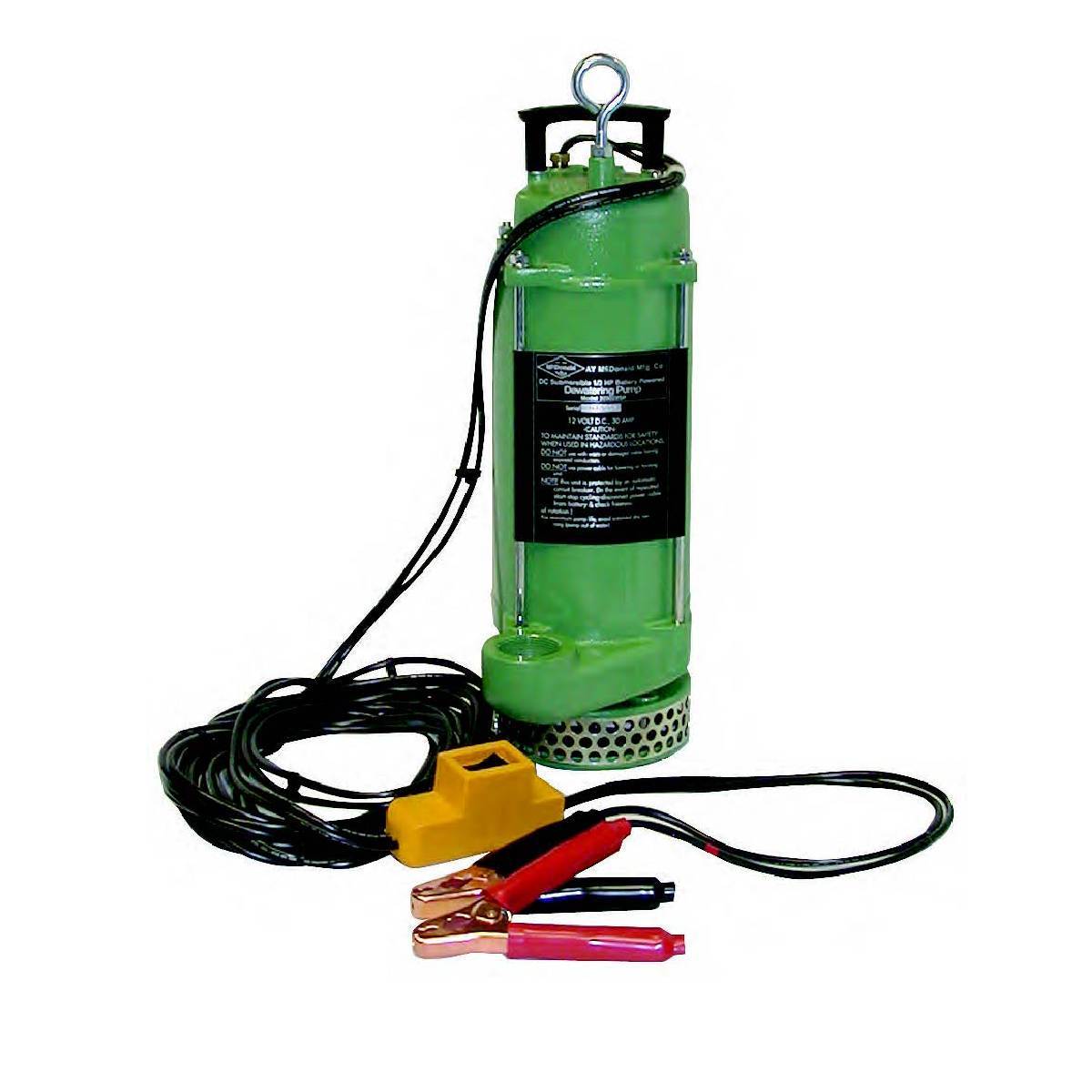
Mini Mac — Compact Submersible Dewatering
Compact submersible electric dewatering pump for vault drainage, manhole pump-down, test pit emptying, confined-space dewatering. Sealed motor, oil-cooled, with cam-lock connection terminals and 50-ft heavy-duty power cable. Drops in via crane/winch hook, runs unattended.
→ Vault & manhole work
Handymac — Portable Surface Dewatering
Portable surface dewatering pump with self-priming centrifugal design and battery-clip / power-cord configuration for jobsite use. Lightweight, single-person carry. Best for foundation pump-out, irrigation transfer, basement flood cleanup, agricultural drainage.
→ Surface portable jobs
When to Use Mini Mac
Submersible electric dewatering — drop pump in water, plug in, walk away. Standard for confined-space pump-out, deep-pit work where the pump can be safely lowered, and routine vault/manhole maintenance. The 50-ft cable handles most municipal vault depths without extension.
→ Submersible duty
When to Use Handymac
Surface portable — pump stays at grade, suction hose drops into water. Standard for emergency basement flooding, foundation pump-out before concrete pour, agricultural irrigation, agricultural transfer, and any application where moving water from a fixed source to a fixed discharge with a portable pump is the goal.
→ Surface portable duty
Why Stock Portable Dewatering When You Sell Godwin?
Godwin lead times for new equipment are typically 4-12 weeks depending on configuration. Most contractors don't have that kind of runway — they need a pump on the truck tomorrow. Mini Mac and Handymac fill the immediate-need gap: portable, electric, ship-today, no engineering required. For larger or more demanding applications, we route to the Godwin lineup for engineered system quotes — typically delivered in 1-2 days, with equipment in 2-4 weeks for stocked configurations.
Complete Site Solution
Power, Control & Equipment
Dewatering rarely happens in isolation. Construction sites, sewer bypass jobs, and emergency response operations need integrated power generation, area lighting, and remote monitoring to keep crews productive and equipment supervised. Godwin provides matched ancillaries.
CXT Power Generators · 23 kW – 327 kW
Diesel-driven generators sized for powering dewatering pumps and light towers from a single fuel source. Single- or three-phase voltages 208V to 480V. Trailer-mounted, fully containerized, EPA Tier 4 compliant. The right call for sites without grid power.
→ Off-grid construction · emergency response
Light Towers — 4-Pole 6,000W Brushless
Trailer-mounted light tower with 4-pole brushless 6,000-W generator and four 1,000-W metal halide lamps. 30-ft mast, 360° rotation, single-person deployment in under 5 minutes. Coverage up to 7 acres, 50-hour runtime per tank. Required equipment for night-shift dewatering.
→ Site lighting · 24-hr ops
PrimeGuard 3 Monitoring & Controls
Microprocessor controller with field smart technology — controls fuel transfer, pump start/stop sequencing, and remote monitoring via cellular or satellite. Industrial-grade pump control panels with full FST/SCADA integration. Required for unattended overnight or remote dewatering operations.
→ Unattended operation · SCADA integration
Strategic Decision · Project Economics
Buy vs Rent Godwin Equipment
Most Godwin business runs through the rental channel — Xylem operates the largest dewatering pump rental fleet in North America. We compete by quoting purchase pricing for contractors and operators where ownership economics work better than rental. Run the numbers carefully.
Lower Capex · Project-Limited Use
Rent It
Per-week or per-month rental
- Best ForSingle-project use, short duration, peaking demand
- Capex$0 — operating expense
- MaintenanceIncluded with rental
- Equipment MixRight-sized per project, swap as needed
- ServiceRental house responds to breakdowns
- DrawbackHigh lifetime cost on continuous-use equipment
- Decision PointIf < 6 months continuous use → rent
Lower Lifetime Cost · Continuous Use
Buy It
One-time capital · own the asset
- Best ForContinuous use, established operations, multi-project
- CapexSignificant upfront — ROI 12-24 months typical
- MaintenanceOwner responsibility — annual service contract option
- Equipment MixFixed configuration — match to dominant use case
- ServiceRoutine maintenance + emergency parts via dealer
- DrawbackCapital tied up; equipment depreciates
- Decision PointIf > 12 months continuous use → buy
The Math: When Buying Pencils Out
Industry rule of thumb: dewatering pump rental at 12-month continuous use typically equals 60-80% of equivalent purchase price. At 18-24 months continuous use, you've paid for the equipment outright but still own nothing. For municipalities, sewer bypass contractors, refinery turnaround operators, and any business with continuous predictable dewatering demand, ownership math wins. For one-off construction projects under 6 months, rental almost always beats buying. We'll quote either side honestly — call 281.664.8000.
Technical Reference
Dewatering Pump Sizing Quick Guide
Three numbers drive Godwin sizing: peak flow demand (GPM), Total Dynamic Head (TDH including discharge run + elevation), and solids handling requirement.
Step 1 — Estimate Required Flow (GPM)
| Application | Typical Flow | Recommended Series |
|---|---|---|
| Vault / manhole pump-down | 50–500 GPM | Mini Mac · Sub-Prime |
| Foundation excavation (small) | 500–1,500 GPM | CD80 / CD100 · Wet-Prime |
| Foundation excavation (large) | 1,500–5,000 GPM | CD150 / CD200 · CD300 |
| Sewer bypass (residential) | 500–2,000 GPM | NC150 · CD150 |
| Sewer bypass (municipal) | 2,000–8,000 GPM | NC200 / NC300 · DBS |
| Mine pit dewatering (small) | 500–3,000 GPM | Heidra 150 / 200 |
| Mine pit dewatering (large) | 3,000–10,000 GPM | Heidra 300 + HPU |
| Hurricane / flood emergency | 1,000–6,000 GPM | CD150 / CD200 / Wet-Prime fleet |
| Wellpoint dewatering | per system design | CD125M / CD150M / CD225M |
Step 2 — Calculate Total Dynamic Head (TDH)
TDH = Static Lift + Discharge Elevation + Friction Losses + Discharge Backpressure
Static lift = water surface to pump centerlineDischarge elevation = pump centerline to discharge pointFriction loss: 6" Sch 40: ~0.5 ft / 100 ft @ 1,000 GPM8" Sch 40: ~0.13 ft / 100 ft @ 1,000 GPMLong discharge runs → upsize pipe diameterIf TDH > 250 ft → choose HL series
Step 3 — Solids Handling & Service Conditions
Clear Water (no solids)
Foundation/excavation pumping where soil has settled, well-pointing return water, treated effluent. Standard centrifugal works.
→ Any CD / NC series
Sandy / Sediment-Laden
Most construction dewatering. Open semi-open impeller required to pass sand without impeller wear.
→ CD trash impeller
Rags / Municipal Sewage
Sewer bypass and aging municipal lines. Self-cleaning vertical impeller prevents ragging.
→ NC series only
Slurry / Sludge / High Solids
Mining slurry, lagoon dewatering, sludge transfer. Centrifugal won't work — need positive displacement.
→ Rotary lobe
Explosive Atmosphere
Mines, refineries, oilfield, chemical plants. Hydraulic-driven submersibles eliminate electric arc risk in pump.
→ Heidra hydraulic
Continuous Unattended Operation
Overnight, weekend, or remote operation requires PrimeGuard 3 controller + cellular monitoring + auto-fuel-fill.
→ Add PrimeGuard 3 + FST
Technical FAQ
Common Questions
What's the difference between a dewatering pump and a sump pump?
Sump pumps are residential equipment — handle clean groundwater, run on 120V household power, lift up to 25 ft, 30-70 GPM. Dewatering pumps are construction/industrial equipment — handle muddy water with sand and gravel, run on diesel or heavy 3Ø electric, move 500-18,500 GPM, lift water hundreds of feet, designed for unattended overnight operation. Different products for entirely different applications. A sump pump won't survive a single shift on a construction site.
Why is Godwin the industry standard for dewatering?
Three reasons: (1) The auto-prime PrimeGuard system actually works — competitors have come and gone but Godwin's vacuum-based prime maintains suction in air-water mixtures that defeat other designs. (2) Open semi-open impeller passes the sand and gravel that comes with construction dewatering without clogging or excessive wear. (3) The diesel drive runs unattended overnight on a single fuel fill — critical for jobs that can't have a watchman next to the pump. Three decades of construction dewatering have proven the design.
CD vs HL vs NC — which Godwin series do I need?
CD (Critically-Damped) is the standard high-volume trash pump for general construction dewatering — up to 18,500 GPM, up to 260 ft head, handles solids to 3". HL (High-Lift) is for high-head applications — long discharge runs, jetting, pressure boosting — up to 540 ft TDH. NC (Non-Clog) is for ragging conditions in municipal sewer bypass — strictly vertical self-cleaning impeller. Pick CD as the default; switch to HL when TDH > 250 ft; switch to NC for municipal sewage applications with rags.
When do I need a hydraulic submersible (Heidra) instead of electric?
Choose hydraulic when: (1) the pit is deeper than ~80 ft and electric motor cable runs become impractical due to voltage drop and conduit cost; (2) the atmosphere is potentially explosive (mining, refinery, oilfield, chemical plant) and electric arc faults are unacceptable — Heidra has zero electric components below the surface HPU; (3) abrasive slurry service where motor heat dissipation is challenging. For typical construction dewatering at depths of 25-80 ft, electric Sub-Prime is simpler and cheaper to operate.
What is wellpoint dewatering and when do I need it?
Wellpoint dewatering lowers the water table around an excavation BEFORE digging starts. A series of small wellpoints (1.5"-2" riser pipes with screened intakes at the bottom) get jetted into the ground around the excavation perimeter, connected to a vacuum-assisted header pipe, and pumped continuously to draw the water table down 10-20 feet across the entire site. Required when the dig is below the existing water table by 5+ feet AND the soil is sandy or saturated where direct excavation would collapse. Standard for Houston commercial deep-foundation work.
Should I buy or rent Godwin equipment?
Industry rule of thumb: rental at 12-month continuous use equals roughly 60-80% of purchase price. At 18-24 months continuous use, you've paid for the equipment but still own nothing. Buy if your dewatering demand is continuous and predictable for 12+ months — municipalities, sewer bypass contractors, refinery turnaround operators. Rent for one-off projects under 6 months. We quote either side honestly.
What's the difference between Mini Mac, Handymac, and Godwin Sub-Prime?
Mini Mac = compact submersible electric for vault/manhole/confined-space pump-down, 50-ft cable, drops in via crane hook. Handymac = portable surface self-priming pump, single-person carry, sits at grade with suction hose. Godwin Sub-Prime = engineered electric submersible series with 6 models from 0.5 HP to 2 HP, 1,100 GPM peak, more substantial than Mini Mac. Mini Mac and Handymac are the in-stock portables; Sub-Prime is the engineered Godwin counterpart for larger work.
Can dewatering pumps be used for permanent installations?
Generally no — dewatering pumps are designed for project-duration use (weeks to months), not multi-year permanent operation. For permanent industrial dewatering, mine drainage, or stormwater pumping installations, we route to Goulds Water Technology commercial pumps or Flygt industrial submersibles. Both offer Xylem-engineered solutions matched to permanent service life expectations. Email specs to sales@watermainsupply.com for engineered quote.
What's PrimeGuard 3 and do I need it?
PrimeGuard 3 is the Godwin microprocessor controller for unattended pump operation. Handles fuel transfer, pump start/stop logic, sequencing of multiple pumps, and remote monitoring via cellular or satellite to a central SCADA system. Required for: unattended overnight operation, remote sites without supervision, sewer bypass jobs requiring 24/7 monitoring, multi-pump installations with redundancy logic. Optional for: short-duration construction sites with daytime supervision and routine fuel checks.
Are you an authorized Xylem / Godwin dealer?
Yes — Watermain Supply (DBA of E4 Industrial LLC) is an authorized Xylem dealer with full portfolio access including Godwin (primary dewatering line), Goulds Water Technology, Flygt, Lowara, and Bell & Gossett. Houston-based with same-business-day quote response on engineered systems and same-day shipping on stocked portable dewatering pumps.
What's the lead time on Godwin equipment?
Stocked configurations of CD150, CD200, NC150, and Sub-Prime typically ship in 1-2 weeks from regional Xylem distribution. Custom-configured systems (DBS sewer bypass packages, Heidra HPU sets, wellpoint header systems) typically run 4-12 weeks depending on configuration and current factory backlog. For immediate need, Mini Mac and Handymac portables ship same-day from Houston stock — bridge for the 1-2 week wait on stocked Godwin or 4-12 week wait on engineered packages.
Do you handle Houston-specific applications like hurricane recovery and refinery turnaround?
Yes — we're Houston-based and routinely quote dewatering for hurricane flood recovery, refinery turnaround flood remediation, parking-garage emergency pump-down, and Gulf Coast construction projects. For emergency hurricane response, we maintain quick-turnaround inventory on portable dewatering and accelerate Xylem regional deployment for engineered packages. Call 281.664.8000 for emergency response quotes.
Need Engineered Dewatering Sized?
Free system sizing on Godwin packages with same-business-day quote response. Same-day shipping on Mini Mac and Handymac portable dewatering from Houston stock.
sales@watermainsupply.com
281.664.8000Free Sizing & Engineered Quotes
sales@watermainsupply.comSame-Day Quote Response
Authorized DealerXylem · Godwin · Goulds · Flygt
- Choosing a selection results in a full page refresh.